Honeycomb Cardboard Packaging: Xiamen Yixin Printing Launches a Fully Custom, Plastic-Free Line
XIAMEN, China, October 2026 — Xiamen Yixin Printing Co., Ltd. has launched a honeycomb cardboard packaging line that covers both the outer box and the protective insert, giving export buyers a paper-based alternative to foam, EVA and molded plastic. The range includes rigid two-piece lid boxes, die-cut honeycomb inserts and colored honeycomb boards, all made to order from a minimum of 1,000 pieces. According to the company, a project can be handled end to end, from structural design and board conversion through to the finished, packed product.
Why Honeycomb Cardboard Is Replacing Foam in Export Packaging
Honeycomb cardboard is a sandwich structure. A hexagonal paper core is glued between two flat face liners, and the open cells behave like a continuous row of small shock absorbers. When a carton is dropped or stacked, the cell walls deform and spread the load across the panel instead of passing it straight through to the product. This is the same principle that makes a beehive stiff for its weight, and it is why a honeycomb panel can carry a heavy static load while remaining light enough to lift with one hand.
That combination of stiffness and low density solves a problem that foam never solved well. Expanded polystyrene and EVA are effective cushions, but they are bulky to store, difficult to recycle in most municipal streams, and increasingly restricted by brand sustainability policies and packaging legislation in major export markets. Honeycomb board is paper, so it can enter standard paper recycling, it can be printed and laminated like any other paper packaging, and it can be packed flat before assembly to save warehouse space.
The material also gives designers something foam does not: a printable, dimensionally stable surface. A honeycomb box can carry brand graphics, handling marks and compliance text on the same panel that protects the product, which removes the need for a separate printed carton around a foam insert. For buyers shipping furniture panels, appliances or electronics, that consolidation is often the difference between a two-component pack and a one-piece pack.
What the New Line Includes: Boxes, Inserts and Board Formats
Rigid Two-Piece Lid Boxes
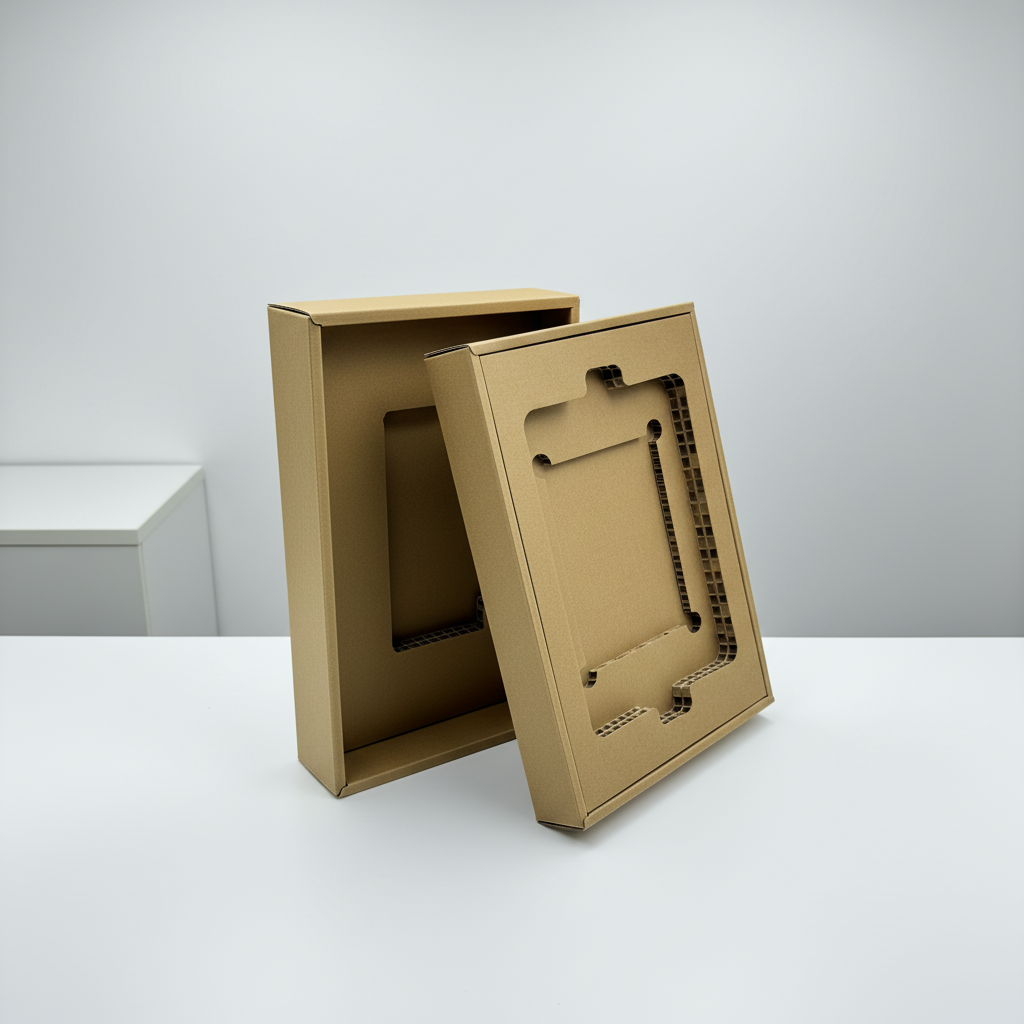
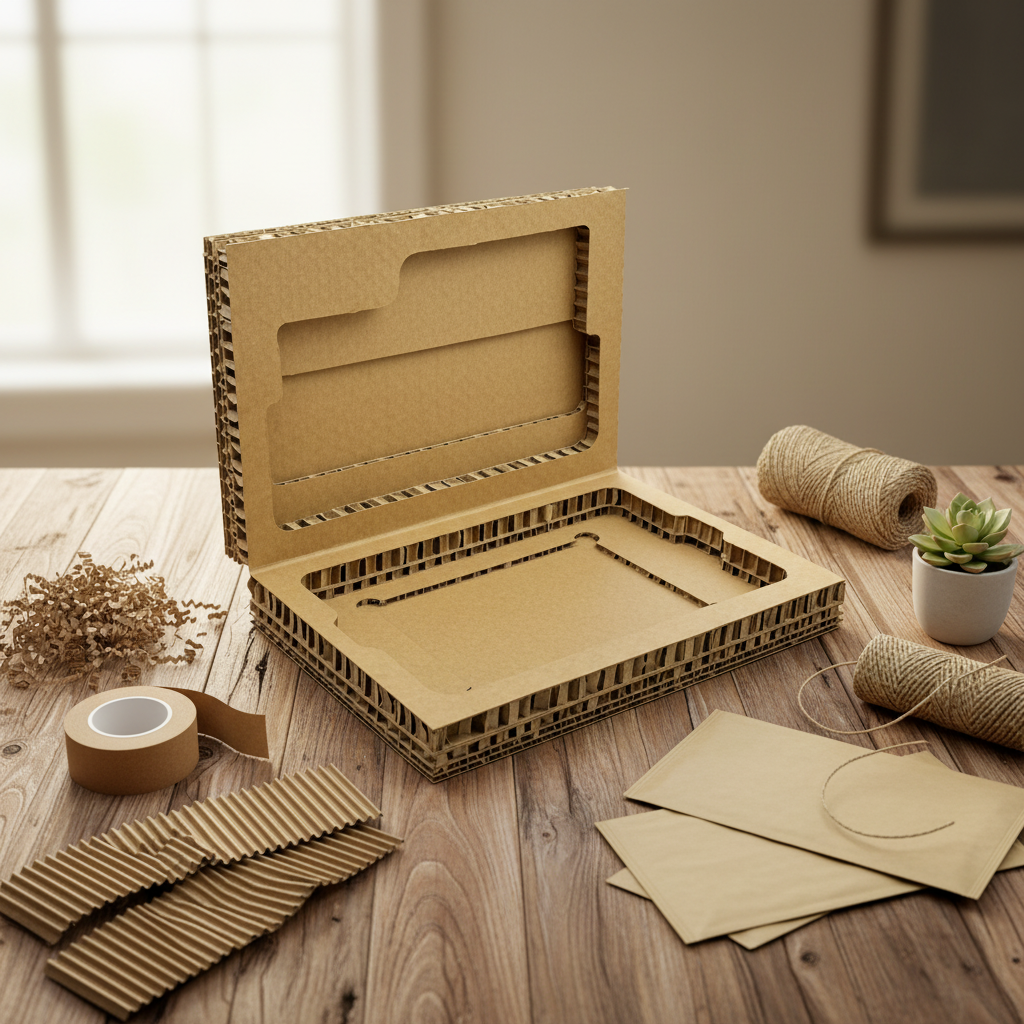
The flagship format is a rigid two-piece lid box built from thickened honeycomb board. The base and the lid are converted separately, then assembled so the lid seats over the base with a consistent reveal on all four sides. Because the board is thick, the box holds its shape without an internal frame, and the edges expose the honeycomb core as a visible design feature rather than a raw cut. These boxes suit presentation and transit use at the same time: they can be printed for retail, then shipped as the primary pack.
Die-Cut Honeycomb Inserts
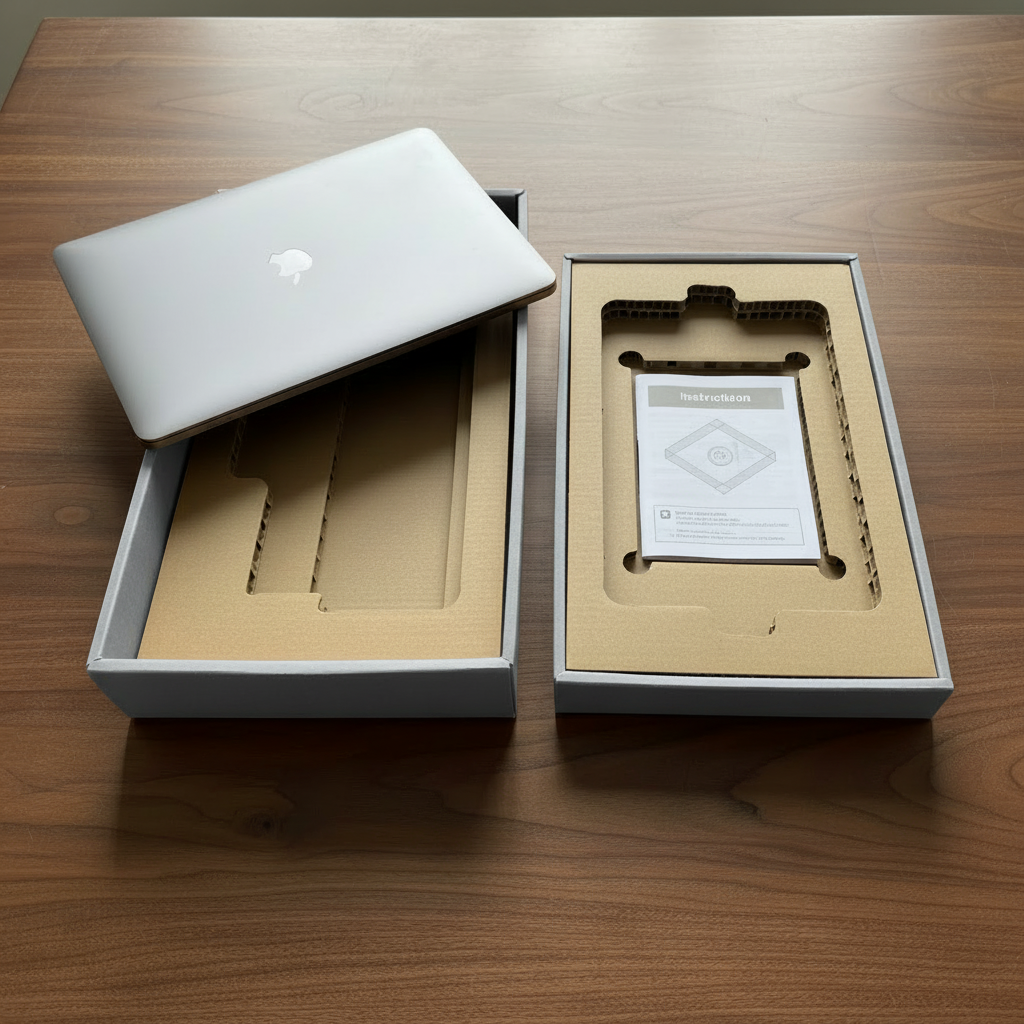
The insert is where most of the engineering happens. A flat honeycomb panel is die-cut so that the cavity follows the outline of the product, including the notches, tabs and finger cutouts needed to lift it out. In the electronics packing shown here, the cavity is shaped around a laptop and a document sleeve, with the core left visible along the cut edge. Unlike a foam insert, the honeycomb insert can be folded and locked from a flat blank, which keeps freight and storage costs down until the pack is assembled.
Colored and Lined Honeycomb Boards
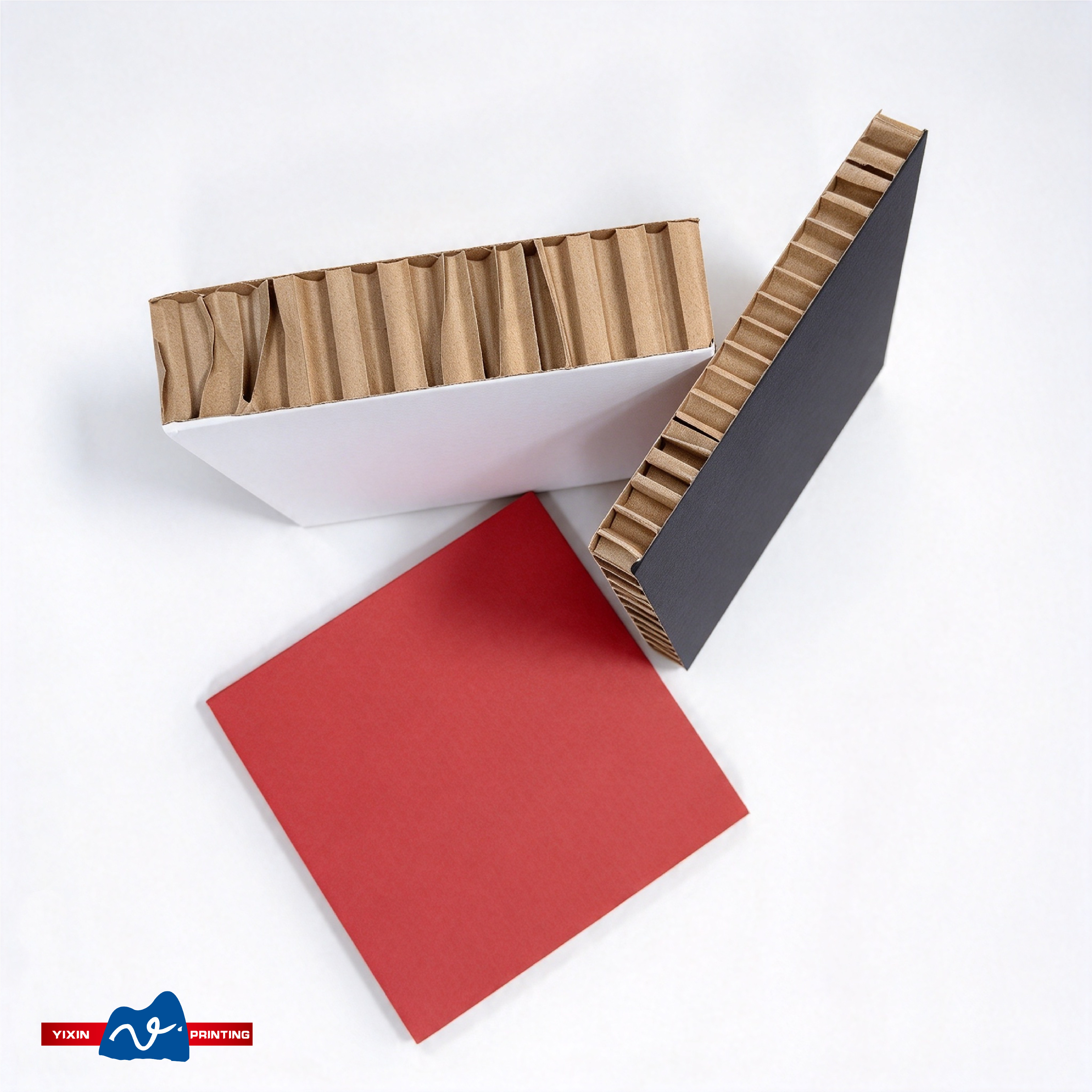
Honeycomb board is not limited to kraft brown. The line includes colored face liners in black, red and white, as well as printed and laminated surfaces. Color is applied to the liner rather than the core, so the structural performance of the panel is unchanged while the visible face carries the brand. This matters for gift, cosmetic and premium retail packs, where the inside of the box is part of the product experience.
Furniture and Flat-Pack Goods
Furniture is one of the largest honeycomb applications. Panels, glass tops, door fronts and flat-pack components are protected with honeycomb edge protectors, corner pieces and layer pads. The material is stiff enough to bridge a pallet span and light enough that it does not add meaningful freight weight, which is why flat-pack furniture exporters use it to replace timber crating and foam corner blocks.
Automotive and Industrial Components
Metal parts, glass, precision instruments and machined components are packed with honeycomb sheets, cradles and edge protectors. The panels provide rigid separation between heavy parts in a pallet load, and the flat paper face gives a stable contact surface against finished components. Industrial buyers also use honeycomb layer pads to stabilize stacked loads.
Food, Beverage and Retail
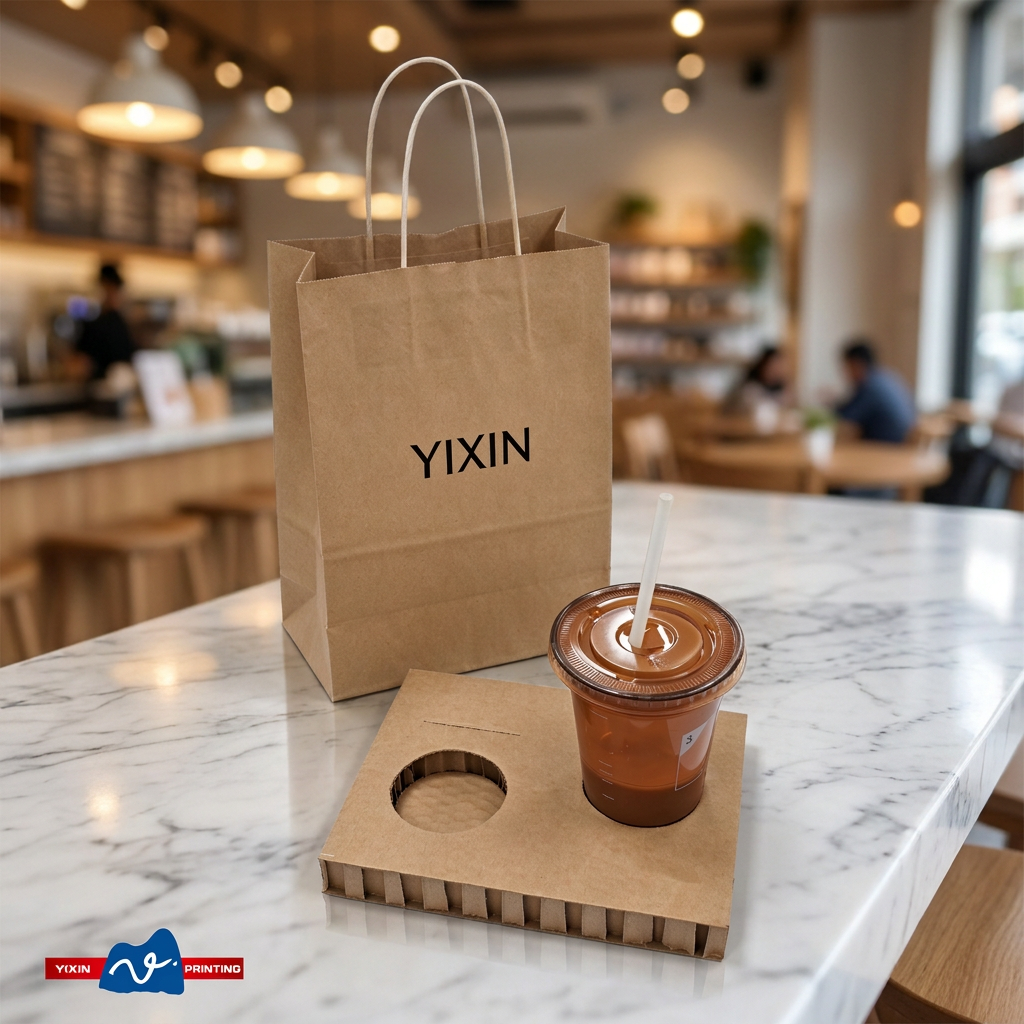
Honeycomb board converts well into cup carriers, tray inserts and display-ready packs. A four-cup carrier can be die-cut and folded from a single honeycomb blank, with the core exposed at the edges to signal the material. In retail, the same board becomes shelf-ready display panels and lightweight signage, combining structural rigidity with a printable face.
E-Commerce and Logistics
Online sellers use honeycomb pads and void fillers to stop products shifting inside a shipping carton, and honeycomb boxes for direct-to-consumer presentation packs. The material can be stored flat and assembled at the packing bench, which reduces the space needed for packaging materials in a fulfillment center.
Construction and Display
Beyond packaging, honeycomb panels are used for lightweight partition cores, ceiling panels, exhibition walls and temporary structures. The panel is rigid, flat and takes print or veneer, so it works as a low-weight substrate wherever a thick, stable board is needed without the weight of timber or the cost of composite panel.
From Structural Design to Finished Box: How the Custom Process Works
A custom honeycomb project starts with the product, not the board. The buyer supplies the product dimensions, weight, center of gravity and any fragile points, together with the outer carton size and the transport route. From that, the structural design defines the cavity layout, the panel thickness, the core direction and the fold lines.
The next step is a die line. Every cut, slot and score is drawn to the finished geometry, because a honeycomb panel cannot be adjusted after cutting the way a foam block can be trimmed. A physical sample is then produced from the die line and tested with the actual product in place, which is the only reliable way to confirm fit, extraction clearance and whether the insert survives a drop test.
Once the sample is approved, production runs on the same die. The company converts the board, assembles the box, inserts the die-cut parts and packs the finished sets for shipment. According to Xiamen Yixin Printing, this end-to-end scope is the reason the line can produce a finished packaging product rather than only supply raw honeycomb sheets.
MOQ 1,000 Pieces: What Buyers Should Prepare Before Ordering
The minimum order quantity for the honeycomb line is 1,000 pieces per order. The threshold is driven mainly by the die and the production setup rather than by the board itself, so a change in size or cavity layout after the die is made becomes a new tooling project. Buyers get the most out of the MOQ by locking the specification before sampling.
A complete brief should include the product drawing with dimensions and weight, the required panel thickness or the load the pack must carry, the finished box size, the face liner and color, the print artwork, the core direction if the design is orientation-sensitive, and the packing method for the finished sets. Destination and transport mode matter too, because humidity and stacking height change how a paper structure performs over a long sea freight.
Buyers who are unsure about thickness should describe the application rather than guess a number. Thickness alone does not predict performance: panel area, core arrangement, liner grade, product contact points and the complete pack all affect the result.
Sustainability and Export Compliance
The environmental case for honeycomb is structural, not marketing. The product is made from paper, so it can be recycled in the paper stream and does not leave a plastic residue in the pack. For brands facing extended producer responsibility fees or single-use plastic restrictions, replacing an EPS insert with a paper insert removes a material that is hard to recycle from the bill of materials.
One caveat is worth stating plainly. Recyclability depends on what is added to the board. Water-based print and an uncoated liner keep the panel inside the paper stream, while heavy film lamination or a plastic window can complicate recovery. Buyers should confirm the finish before repeating a recyclability claim on the pack itself.
For export, paper packaging also avoids the phytosanitary treatment associated with solid wood. Honeycomb pallets and paper crates do not require heat treatment or fumigation certificates, which simplifies documentation for markets that regulate wood packaging. Buyers should still confirm the exact requirement with their freight forwarder, because rules vary by destination and by product category.
FAQ
What is honeycomb cardboard packaging?
Honeycomb cardboard packaging is a paper-based structure made from a hexagonal paper core bonded between two face liners. It is converted into boxes, inserts, pads, dividers and edge protectors. The cells give the panel its stiffness and cushioning, while the flat liners provide a printable surface and a stable contact face for the product.
Can honeycomb inserts replace EVA foam or EPS?
In many electronics, appliance and furniture packs, yes. The die-cut cavity performs the same locating and cushioning role as a foam cradle, and the paper structure can be tuned through panel thickness, cell size and cavity geometry. Whether a specific product can switch depends on its weight, fragility and drop-test requirement, which is why a physical sample should be tested before the die is released.
What is the minimum order quantity?
The minimum order quantity is 1,000 pieces per order. Because the cost is driven by the die and the production setup, consolidating sizes into one design reduces the effective cost per unit.
What information does Xiamen Yixin Printing need for a quote?
A product drawing with dimensions and weight, the required finished box size, the panel thickness or load requirement, the face liner and color, the print artwork, and the destination. A sample or reference pack helps confirm the cavity layout before quoting.
About Xiamen Yixin Printing Co., Ltd.
Xiamen Yixin Printing Co., Ltd. is a packaging manufacturer based in Xiamen, China, producing custom printed paper packaging, including honeycomb cardboard boxes, die-cut honeycomb inserts and colored honeycomb boards. The company accepts fully customized orders from 1,000 pieces and handles projects from structural design through to the finished packaging product.
